Variant catalogue

These are the names pencilmark gives a puzzle when its rules match a known pattern: describe() and meta.type use them ("Samurai Sudoku", "Argyle Sudoku"). They are a library feature, not part of the puzzle format: a samurai file is five box_grid rules and an Argyle file a few region rules, so any reader that reads those reads the puzzle, and no reader needs to know the names. How variants are named gives the exact matching rules; rule families such as killer cages and thermometers have their own pages under Rule families. For an introduction to the popular variants, see Artisanal Sudoku's basics of popular sudoku variants.

Placement variants​

A placement variant adds fixed regions to one grid. pencilmark recognises it when every region it adds is present, on any board size where it is defined.
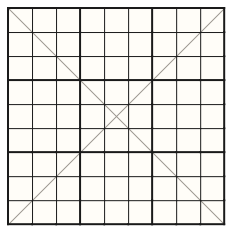
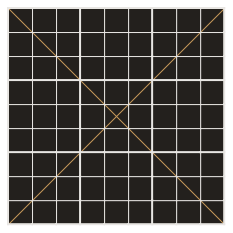
X (Diagonal)X (Diagonal)
X (Diagonal)
Digits don't repeat on either main diagonal. Any size.
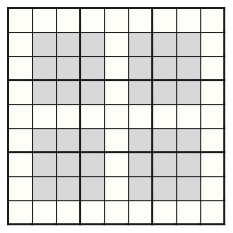
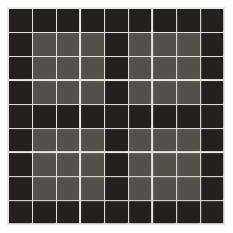
Windoku (Hyper, NRC)Windoku (Hyper, NRC)
Windoku (Hyper, NRC)
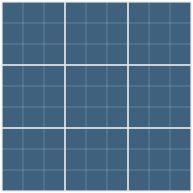
Digits don't repeat in the shaded windows. 9×9 has four; 16×16 has nine.
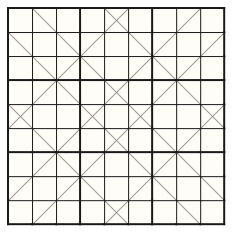
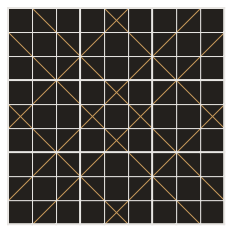
ArgyleArgyle
Argyle
Digits don't repeat on any of the eight marked diagonals. 9×9 only.
AsteriskAsterisk
Asterisk
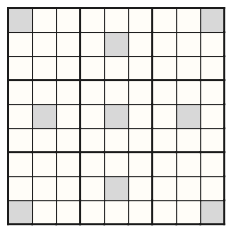
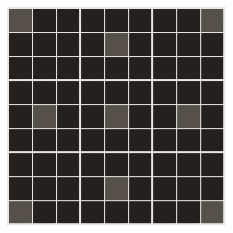
Digits don't repeat in the nine shaded cells. 9×9 only.
Centre-dotCentre-dot
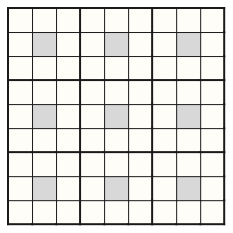
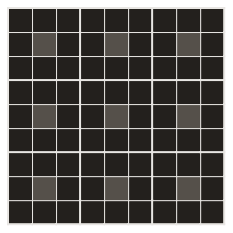
Centre-dot
Digits don't repeat among the centre cells of the boxes. Boxes with odd sides.
GirandolaGirandola
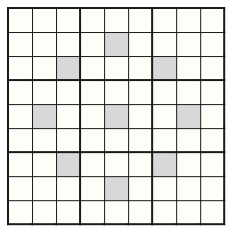
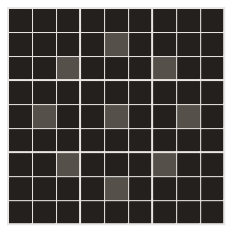
Girandola
Digits don't repeat in the nine shaded cells. 9×9 only.
Disjoint Groups (Colour)Disjoint Groups (Colour)
Disjoint Groups (Colour)
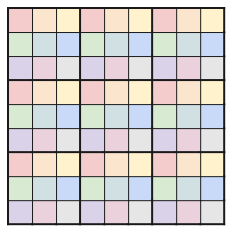
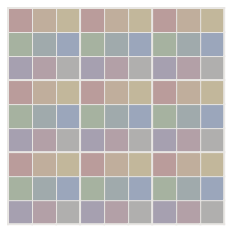
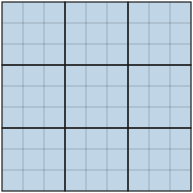
Cells in the same position in each box contain different digits.

Multi-grid layouts​

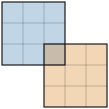
A multi-grid board is written as one box_grid per 9×9 grid (Houses and regions). When the grids' top-left cells match a named layout, the puzzle takes its name: "Samurai Sudoku", "Killer Twodoku". In the drawings, overlapping grids have different tints, so the shared boxes show as a blend. Another arrangement is a "Multi-Grid Sudoku" and is graded the same way.
TwodokuTwodoku
Twodoku
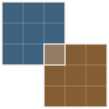
2 grids sharing one box. 15×15.
DoubledokuDoubledoku
Doubledoku
2 grids sharing four boxes. 12×12.
TwinTwin
Twin
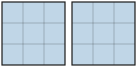
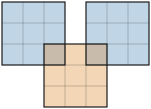
2 grids side by side with a one-column gap. 9×19.
SenseiSensei
Sensei
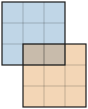
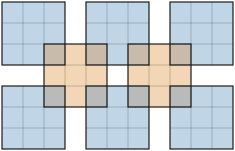
2 grids sharing two boxes. 15×12.
TridokuTridoku
Tridoku
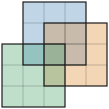
3 grids in a triangle, each sharing boxes with the other two. 15×15.
Gattai-3Gattai-3
Gattai-3
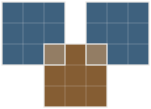
3 grids: two at the top, one below between them. 15×21.
ButterflyButterfly
Butterfly
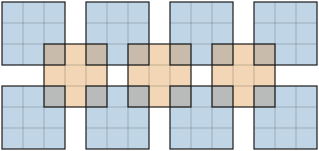
4 grids in a 12×12 square.
FlowerFlower
Flower
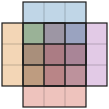
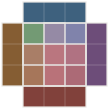
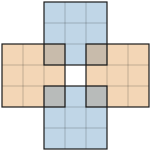
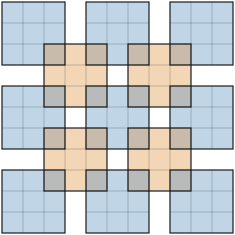
4 grids around a centre grid. 15×15.
SoheiSohei
Sohei
4 grids in a diamond. 21×21.
Samurai (Gattai-5)Samurai (Gattai-5)
Samurai (Gattai-5)
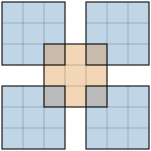
4 corner grids joined by a centre grid. 21×21.
Windmill (Kazaguruma)Windmill (Kazaguruma)
Windmill (Kazaguruma)
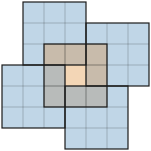
4 grids turning around a centre grid. 21×21.
Super SamuraiSuper Samurai
Super Samurai
8 grids in rows of 3, 2 and 3. 21×33.
Clueless 1 and 2Clueless 1 and 2
Clueless 1 and 2
9 grids in a square, plus a tenth grid made of the centre cells of every box (Clueless 1) or the centre box of every grid (Clueless 2). 27×27.
ShogunShogun
Shogun
11 grids in rows of 4, 3 and 4. 21×45.
SumoSumo
Sumo
13 grids in rows of 3, 2, 3, 2 and 3. 33×33.